Carbon Steel Fabrication: How to Choose the Right Steel Grade for Your Application
What are the consequences of choosing the wrong type of steel? It could lead to cracks during welding, requiring on-site rework; it could cause structural deformation, resulting in delivery delays; or it could cause the product to fail prematurely during use, with the responsibility falling on the manufacturer. In the field of carbon steel fabrication, material selection is never just a matter of “referencing a manual”. It directly affects costs, process difficulty, and delivery time.
Based on the actual perspective of the front-line manufacturing, the following presents a clear selection logic.
How Do I Choose a Carbon Steel Grade for My Application?
All material selection decisions start from one question: What is the failure mode of this part?
Best Choice for Welded Structures and Forming Applications
For example, in scenarios such as building structures, bridge frameworks, and equipment bases, the required materials should have good plasticity and welding properties, and their strength should only need to meet the static load requirements.
Balanced Strength and Machinability for Mechanical Parts
For instance, rotating shafts, gears subjected to impact, and reciprocating connecting rods. These components require both strength and toughness and must also be easy to machine.
When Hardness and Wear Resistance Matter Most
For example, in applications involving cutting edges, molds, and springs, there are strict hardness requirements. Because of its high carbon content, it offers excellent hardness and wear resistance but requires more careful consideration during welding and machining.
Our value:You don’t have to go through the manual to make your own judgment. Based on your usage scenario, we directly determine the major material categories and narrow down the selection range. If your part does not require the “hard” attribute, we will clearly advise you to avoid high-carbon steel, as the inconvenience and difficulties in welding and processing it far outweigh the benefits.
How Carbon Steel Fabrication Processes Affect Material Selection
Many suppliers only select carbon steel based on its tensile strength. However, the risks in mass production projects usually do not lie in the strength itself, but in the three stages of the manufacturing process:
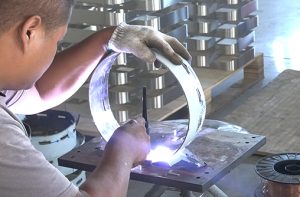
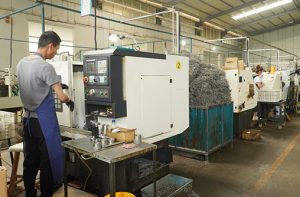

Welding Applications: Why Low Carbon Steel Is Commonly Used
Welding is the most common connection method in carbon steel manufacturing and also serves as a “threshold” for material selection. If your structure requires extensive welding, we will recommend low-carbon steel as the preferred option. It has a high tolerance for welding processes and a stable heat-affected zone. It does not require complex preheating or post-weld heat treatment. Only in this way can the welding station remain stable and produce quality work without causing batch rejections due to a too-narrow process window.
CNC Machining Parts: When Medium Carbon Steel Provides Better Performance
If you require high precision in turning, milling, or drilling, the chip-breaking performance of medium carbon steel is superior to that of low carbon steel. The surface finish can be more easily guaranteed. Low-carbon steel has excessive toughness, making it prone to “sticking to the tool” and leading to accelerated tool wear and frequent tool changes, thereby directly reducing the effective output of the production line.
Stamping and Forming Parts: Material Formability Determines Production Stability
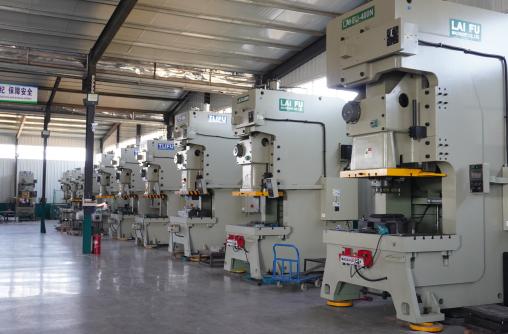
During mass production, the stability of material supply and batch consistency are of utmost importance. Based on your production method and equipment conditions (whether it’s a punch press or a hydraulic press, whether it’s a continuous mold or a single-station), we recommend the appropriate grades and corresponding process windows. This ensures that the material selection plan can be implemented on the production line rather than remaining only in laboratory data.
Carbon Steel Grade Selection Guide for Different Manufacturing Requirements
Our engineering team will, based on your drawings, conduct a detailed assessment one by one:
| Application / Manufacturing Requirement | Our Recommendation | Why |
|---|---|---|
| Large welded structural frames | Q235 / A36 | Excellent weldability, no preheating required, lowest cost |
| Sheet metal bending + welded enclosures | Q235 / A36 | Balances formability and weldability, no cracking at bend lines |
| CNC-machined shafts and axles | 1045 / 45 Steel | Good machinability, strength meets dynamic loads after quenching and tempering |
| High-load mechanical fasteners | 1045 / 45 Steel | Balanced mechanical properties, best cost-performance ratio |
| Wear-resistant functional parts | High-carbon steel series | Hardness is the priority; we also provide alternative solutions for welding compatibility |
Our value: You don’t have to struggle between weldability and machinability. We provide you with the optimal grade based on your process route and offer alternative options to help you make a clear comparison between cost and performance.
What Carbon Steel Selection Mistakes Should OEM Buyers Avoid?
Misconception 1
Is Higher Strength Carbon Steel Always Better?
In reality, the welding performance may not meet the standards, and the welds crack first. We have encountered actual cases: A client used steel of a higher strength grade for the equipment frame, but during on-site welding, cold cracks occurred, and everything had to be reworked. Strength is a design indicator, but manufacturing feasibility is the prerequisite for mass production.
Misconception 2
Steel Grade Consistency Matters More Than Brand Names
The carbon equivalent of the same brand name materials from different steel mills varies. Switching steel mills may require re-adjusting welding parameters. Our approach is: For each batch of materials, we check the quality certificate to lock in the supplier and ensure consistency between batches.
Misconception 3
Material Testing Before Mass Production Reduces Risk
Switching materials often involves redoing the welding process assessment, which is costly and time-consuming. Our suggestion is: First, send samples to confirm the material selection and process, and then lock in the batch material plan, placing the risk at the sample stage.
Not only carbon steel but also stainless steel, galvanized sheet, aluminum alloy, and other metal materials all have issues related to material selection. Understanding the key points of metal material selection can help you compare different materials.
Our Carbon Steel Fabrication Process from Material Selection to Mass Production
From the design drawings to stable mass production, we ensure the correct material selection through four key stages:
01
Analyze Operating Environment and Steel Grade Requirements
The “quality grades” of steel (A, B, C, D) determine its reliability in different environments. This aspect is often overlooked by first-time buyers who manufacture carbon steel.
Our approach : After obtaining your usage environment parameters, we will proactively verify whether the equipment is used outdoors. Is the working temperature lower than -20℃? Does the structure withstand dynamic loads or impacts? If the answer is “yes”, we recommend choosing grade C or D to ensure that the low-temperature impact toughness meets the standards.
Our value : You don’t need to become an expert in material standards. We help you identify potential environmental risks in advance and avoid hidden failures such as low-temperature fracture.
02
Validate Material Selection Through Prototype Samples
After determining the recommended model, we will directly process a sample according to your drawings and send it to you. We will create a real part using your final manufacturing process, allowing you to test it before mass production:
- Dimensions and accuracy : All critical dimensions are processed according to the drawings. You can directly measure them to confirm whether the processing accuracy meets the assembly requirements.
- Surface and appearance :The quality of weld formation, surface smoothness, and whether there are wrinkles or cracks on the bending arc — it’s obvious when you hold it in your hand.
- Assembly matching : If it is a structural part or a connecting part, you can directly install it on the equipment for trial fitting to confirm whether the hole positions and shape tolerances are appropriate.
Our value proposition : You don’t have to place a large order upfront to “bet” on the correctness of the material selection. We provide free samples, and you can start mass production only after confirming that everything is fine. This saves not only rework costs but, more importantly, your own verification time and effort. Visually presenting the product to convince your internal team or customers is far more persuasive than any data manual.
03
Verify Material Performance Before Production
Before finalizing the model number, our engineers conducted a final review using three questions:
- Is welding necessary? → If yes, choose low-carbon steel; if not, consider medium-carbon steel.
- What is the main force-bearing method of the part? → For static load, choose low-carbon steel; for dynamic load, choose medium-carbon steel; for wear resistance, choose high-carbon steel.
- Is there any low temperature or corrosive factor in the working environment? → If yes, increase the quality grade (C grade or D grade).
04
Lock Material Standards for Stable Mass Production
After passing through three stages – environmental review, sample verification, and final inspection – the material grade and supplier are determined, and the stable mass production stage is entered. For each batch of materials, the quality guarantee certificate is checked to ensure consistency between batches.
In Carbon Steel Fabrication, there is no “best” material; there is only the solution that is most suitable for your production goals.
carbon-steel-fabrication-how-to-choose-the-right-steel-grade-for-your-application.txt
Frequently Asked Questions
How do I choose the right carbon steel grade for my application?
Start from the operating environment and work backwards to the grade. Load and stress, corrosion exposure, operating temperature, and the joining or forming process all narrow the options before price is considered. Then check whether the candidate grade can actually be fabricated the way the drawing requires: some grades weld cleanly but resist bending, others machine well but distort after welding. The grade is confirmed against the real process route, not against a data sheet alone, because behaviour changes once the material is cut, formed, and joined.
Why does the fabrication process affect which carbon steel grade is suitable?
Because each process puts different demands on the material. Welding relies on low carbon content for a stable weld pool and lower cracking risk, so low carbon steel is the common choice. CNC machined parts are often better served by medium carbon steel, which holds machined surfaces and strength more reliably. Stamping and forming depend on formability: if the material cannot take the bend or the draw without cracking or excessive springback, the grade is wrong no matter how good its mechanical data looks on paper.
Is higher strength carbon steel always the better choice?
No, and this is one of the most common selection mistakes. Higher strength usually means lower ductility, which makes forming harder, increases springback, and can raise welding difficulty. If the part does not need the extra strength, the higher grade adds cost and process risk without adding value. The practical question is not how strong the steel can be made, but what strength the application actually requires and whether the process can deliver it consistently at volume.
Why does material consistency matter more than the steel brand?
Because production stability depends on repeatability, not on a logo. Even a well-known grade varies in chemistry tolerance, thickness, hardness, and surface condition between suppliers and batches. When those inputs shift, the same drawing and the same tooling can produce different results, and the problem appears as dimensional drift or forming defects rather than as an obvious material failure. That is why the grade and the supplier are fixed, and the quality certificate is checked against each incoming batch before production.
How do you reduce the risk of choosing the wrong steel grade?
By proving the choice before the batch is committed. The sequence used here is: analyse the operating environment and the reliability grade the part needs, produce a real sample using the final manufacturing process, verify performance through a final engineering review, and only then lock the material standard for mass production. Placing the risk at the sample stage costs far less than discovering a material mismatch after tooling and batch production are already running.
Send Your Drawings — We’ll Help You Choose the Right Carbon Steel
✅ Environment review · Welding matching · Free sample validation
📩 tylor@xinjiuxinji.com — Reply in 3 working hours with free design optimization.
📌 Send Your Drawings — Get Expert Support for Your Carbon Steel Fabrication Project
Custom Metal Parts – One Factory, One Team, No Handoffs