Choosing Sheet Metal Finishes: What OEM Buyers Often Get Wrong
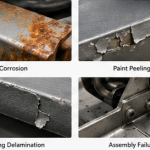
In many OEM projects, the parts fully comply with the drawing requirements for size, material, and processing. However, after delivery, they exhibit corrosion, peeling paint, coating detachment, or assembly failure.In most cases, the problem is not manufacturing quality, but an incorrect selection of sheet metal finishes at the early engineering stage.
Surface treatment is not “appearance processing” but rather an engineering decision that directly affects the product’s lifespan, reliability, and batch consistency.
Why Sheet Metal Finishes Are an Engineering Decision
Many OEM buyers consider surface treatment merely as the final step in production, with its main functions being aesthetic appeal or rust prevention. However, in actual manufacturing systems, sheet metal finishes directly affect product performance and manufacturing outcomes.
For example, a finish decision can determine whether a product:
- resists corrosion in outdoor or humid environments
- maintains wear resistance under repeated mechanical contact
- supports or disrupts electrical conductivity requirements
- ensures coating adhesion stability over time
- allows or limits post-processing such as welding or machining
- maintains dimensional stability after forming or thermal exposure
- keeps manufacturing costs predictable in mass production
- achieves consistent quality across large batches
For instance, for the same type of outdoor equipment, different corrosion protection grades will determine completely different surface treatment schemes. If the selection is incorrect, even if there seems to be no problem at the sample stage, it may fail very quickly in the actual environment.
Therefore, the professional engineering team does not regard surface treatment as the “final step”, but considers it as part of the product design.
In engineering practice, sheet metal finishes selection follows a structured decision sequence: environment → material → function → process capability.
What Should Drive the Finish Choice?
Surface finish selection always starts from environment, not from cost or appearance.
Indoor environment
- Low corrosion risk
- Powder coating or electroplating can be used
- Cost efficiency and appearance are the priority
Outdoor environment
- UV exposure + rain + temperature variation
- Requires higher corrosion protection systems (e.g., galvanizing + coating)
Marine / coastal environment
- High salt-spray corrosion
- Hot-dip galvanizing or dual-layer protective systems are required
Chemical / industrial environment
- Strong corrosive media
- Requires specialized coatings or stainless steel solutions
👉 Engineering principle: Environmental severity determines the level of surface protection, not cost considerations.
How Does the Material Limit Which Finishes Are Available?
Material defines the available finishing range, not personal preference.
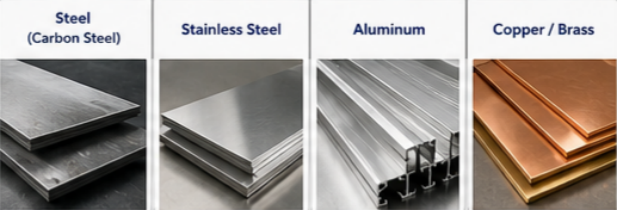
Steel (Carbon Steel)
- Requires external corrosion protection systems
- Common finishes: galvanizing / powder coating / black oxide
Stainless steel
- Focus on surface condition optimization
- Common finishes: passivation / electropolishing / sandblasting
Aluminum
- Relies on oxide layer protection
- Common finishes: anodizing / powder coating
Copper / Brass
- Requires oxidation resistance and appearance stability
- Common finishes: nickel plating / clear coating
👉 Common mistake: Applying incompatible surface finishes to a material can lead to poor adhesion and early failure.
What Are the Most Common Finish Mistakes OEM Buyers Make?
Many surface treatment failures are due to poor decision-making rather than process issues.
- 1. Appearance-driven selection – Appearance is a result, not an engineering requirement.
- 2. No defined environment at design stage – Without a clear operating environment, corrosion protection levels cannot be properly defined.
- 3. Separating material and surface treatment – Material and surface finish must be designed as an integrated system.
- 4. Cost-first decision logic – The lowest unit price often leads to the highest lifecycle cost.
- 5. Late-stage decision making – Changes made during mass production are costly and often no longer optimizable.
Surface Finish Selection Matrix
The following engineering matrix provides a practical reference for selecting sheet metal finishes based on real OEM production conditions.
Why Manufacturing Stability Matters
Surface finish stability is not determined by coating alone. It depends on how stable the upstream manufacturing process is.
For example:
- If stamping is unstable, surface stress distribution will vary
- If welding heat is uncontrolled, coating adhesion will weaken
- If machining tolerance fluctuates, coating thickness becomes inconsistent
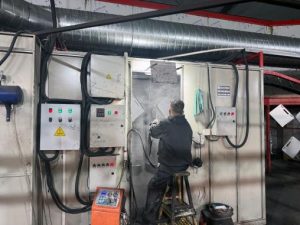
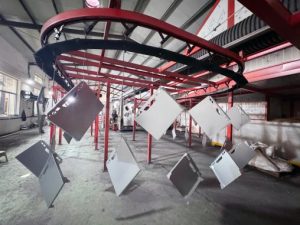
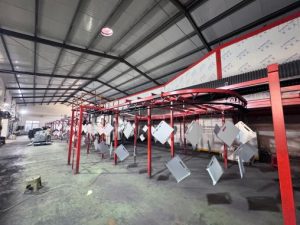
Without upstream process stability, even the correct surface finish selection can fail in mass production.
To control these variables, manufacturing stability must be integrated into the system.
👉 Our production system supports this stability through:
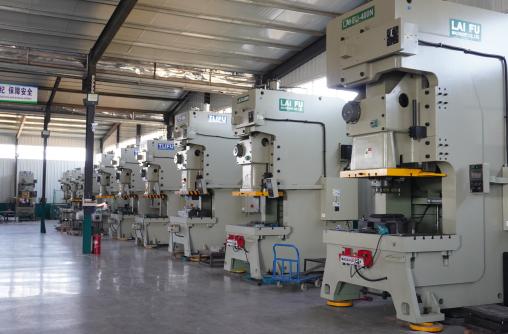
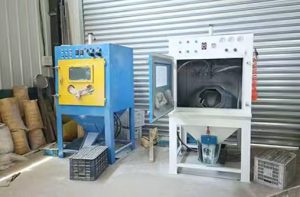
Behind this process stability is an integrated manufacturing system. Our 9,000㎡ production facility combines 38 stamping presses (80–400T), two automated surface treatment lines, two CMM inspection systems, and a team of 19 experienced engineers working under an ISO 9001:2015 quality management system. This allows us to maintain consistent surface quality from prototype to high-volume production.


How We Support OEM Projects from Design to Production
Most OEM failures related to sheet metal finishes do not come from the coating itself, but from early-stage engineering decisions.
That is why our customers do not come to us for finishing alone—they work with us because we help them make better engineering decisions before production starts.
Our support typically includes:
- Early-stage DFM analysis to identify manufacturability risks
- Material and surface finish compatibility evaluation
- Application-based finish recommendation rather than catalog selection
- Rapid prototype validation within 72 hours
- Pre-production inspection using CMM systems to ensure dimensional stability
- Controlled mass production with consistent finishing quality
This engineering-first approach reduces downstream risks such as corrosion issues, coating failure, or assembly mismatch.
Combined with our 9000㎡ production system, 19 senior engineers, ISO 9001:2015 certification, and over 70,000+ custom parts delivered to 100+ countries, we provide not just manufacturing capacity—but engineering reliability.
Conclusion
The selection of sheet metal finishes is not a material choice or a surface treatment choice.
It is an engineering decision that must balance:
- Environmental conditions
- Material behavior
- Functional requirements
- Manufacturing stability
When any one of these factors is ignored, surface failure becomes inevitable.
Frequently Asked Questions
Why is finish choice an engineering decision rather than a cosmetic one?
Because it changes how the part performs and how the process behaves. Many OEM buyers treat surface treatment as the final step whose purpose is appearance or rust prevention, but in a real manufacturing system the finish affects protection, assembly, and service life. A finish decision can determine whether a product survives its environment and whether the upstream process stays stable. Treating it as decoration pushes the choice to the end of the project, where it is most expensive to change.
What should a finish be chosen from: cost, appearance, or the environment?
The operating environment comes first. Selection should start from where the part will live rather than from cost or appearance: an indoor steel part can be served by powder coating at low cost for cost efficiency, an outdoor steel part needs corrosion resistance, typically galvanizing plus coating at medium cost, and a marine steel part needs high durability, which normally means a duplex coating system at high cost. Appearance is the result of that decision, not the input to it.
How does the material limit which finishes are available?
Material defines the available finishing range rather than personal preference. Steel, aluminium, and stainless steel each support different processes: galvanizing, powder coating, and black oxide are common on steel, aluminium is typically anodized, and stainless steel may be left bare or passivated. Choosing a finish the material cannot support creates adhesion or corrosion problems that no amount of coating inspection can fix, which is why material and finish have to be decided together.
What are the most common finish mistakes OEM buyers make?
Most failures come from decisions rather than from the coating process itself. Appearance-driven selection is the most common: a finish is chosen because a sample looked right, and it turns out to be wrong for the environment. Others include specifying a finish the material cannot carry, deciding after the geometry is fixed so that liquid pools inside bends, and assuming that coating will compensate for unstable upstream processes. All of them are avoidable at the design stage.
Why does upstream manufacturing stability affect the finish?
Because the coating only reproduces what the surface gives it. Surface finish stability is not determined by the coating alone: if stamping is unstable, the surface stress distribution varies, and pretreatment and adhesion behave differently across the batch. Rework, handling damage, and inconsistent deburring show through the coating, so appearance and corrosion performance drift even though the finishing line has not changed. Stable forming and controlled surface preparation are what make a finish repeatable.
Get the Right Surface Finish for Your OEM Project
✅ Environment-based selection · Material compatibility · Long-term reliability
📩 tylor@xinjiuxinji.com — Reply in 3 working hours with free design optimization.
Many surface finish failures come from early-stage selection errors, not manufacturing issues. Upload your drawings for a professional finish recommendation based on your application environment.
Is Low Volume Manufacturing Right for Your Next OEM Project?