Compare Metal Fabrication Quotes by Scope
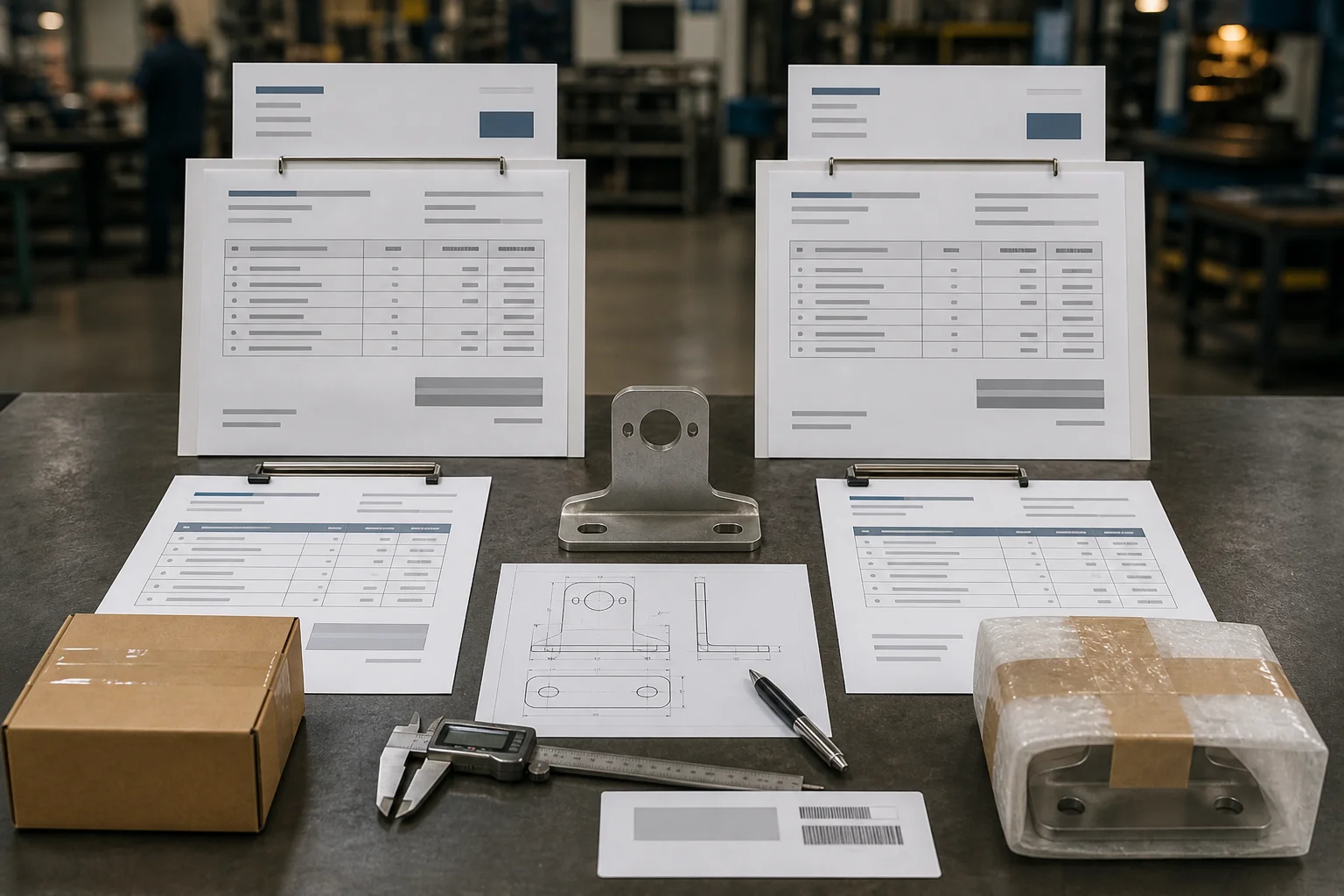
Illustrative editorial image only; it does not show actual supplier quotations, prices, or commercial terms.
This method suits OEM, engineering, and procurement teams that buy laser-cut, formed, machined, welded, or assembled metal parts from China. It does not assume that a supplier’s price difference reflects a market rule. Instead, procurement teams should explain each difference through scope, assumptions, capacity, process, risk allocation, or data that still needs confirmation.
Compare Metal Fabrication Quotes with a Nine-Line Checklist
Send the same checklist to every qualified supplier and ask each one to mark included, excluded, or to be confirmed. Then keep the checklist with the quote revision, so every later comparison starts from the same record.
| Row | Scope field | Questions to answer before comparison |
|---|---|---|
| 1 | Part identity and revision | What part number, drawing revision, CAD file, and change level are being priced? |
| 2 | Quantity and demand pattern | What order quantity, forecast, batch size, and annual demand are assumed? |
| 3 | Material and condition | What alloy or steel grade, product form, condition, thickness, and tolerance are included? |
| 4 | Process route | Is the quote for cutting, bending, machining, welding, assembly, or a defined combination? |
| 5 | Finish and appearance | Which pretreatment, coating, plating, passivation, anodizing, brushing, or cosmetic standard is included? |
| 6 | Quality and inspection | What certificates, dimensional reports, tests, samples, and acceptance criteria are included? |
| 7 | Tooling and setup | Are dies, fixtures, programs, jigs, gauges, samples, and setup charges included, owned, or refundable? |
| 8 | Packing and logistics | What packing method, marks, shipment mode, Incoterm, destination, and freight assumptions apply? |
| 9 | Commercial terms | What currency, payment schedule, quote validity, lead time, warranty, change handling, and exclusions apply? |
Even so, a supplier should not be penalized for a clearly stated exclusion. Nevertheless, buyers should add that exclusion to the comparison model. For example, if one quote includes a report and another does not, do not call the first quote “expensive” until the same evidence is priced for both.
Use one landed-cost formula
Use a single formula for every supplier. Then apply it to the same scope lines:
Landed cost = quoted manufacturing price + tooling/setup allocation + inspection/testing + packing + origin charges + freight + insurance + duties/taxes/fees + bank/payment costs + expected rework or compliance allowance − documented credits
The formula is a decision model, not a claim that every charge applies to every shipment. Mark each line as included, excluded, or to be confirmed. Keep unit cost and total order cost separate. Tooling may be a one-time charge, while freight or inspection may vary by shipment. Without the destination or Incoterm, the landed cost cannot be compared yet. Therefore, request the missing commercial data directly from the supplier rather than estimating internal prices from this article.
Comparison worksheet
| Cost line | Supplier A | Supplier B | Status / evidence required |
|---|---|---|---|
| Manufacturing price, currency and quantity basis | To fill | To fill | Confirm unit, batch, and currency |
| Tooling and setup | To fill | To fill | Confirm ownership, amortization, and replacement |
| Inspection and certificates | To fill | To fill | Attach inspection plan and report list |
| Finish and rework allowance | To fill | To fill | Confirm finish specification and acceptance |
| Packing and origin charges | To fill | To fill | Confirm packing level and export charges |
| Freight, Incoterm, and destination | To fill | To fill | Same destination and shipment assumption |
| Duties, taxes, and fees | To fill | To fill | Confirm buyer or seller responsibility for each charge |
| Payment and bank costs | To fill | To fill | Include financing or transfer costs when relevant |
| Landed cost | To calculate | To calculate | Use the same formula and assumptions |
Request comparable quotations instead of using published price examples
Therefore, send every qualified supplier the same drawing revision, quantity, material, finish, inspection plan, Incoterm, destination, payment preference, and delivery window. Then ask each supplier to return the nine scope lines with inclusions, exclusions, and assumptions stated in writing.
For any missing field, mark it to be confirmed rather than entering a guessed value. Also, request a formal quotation from the supplier after technical review, because a general article cannot replace a project-specific commercial offer.
Compare Incoterm and destination line by line
Incoterms allocate defined responsibilities, but an Incoterm by itself is not a freight quote. Therefore, record the named place, shipment mode, delivery window, and the party that pays each charge. “FOB” without the named port, or “delivered” without the destination address, leaves a landed-cost comparison incomplete. Confirm whether the destination is a port, airport, warehouse, or named delivery point, and whether duties and local taxes are included or excluded.
Ask suppliers to state the following details, so that every quote uses the same logistics basis:
- Incoterm version and named place;
- origin pickup or port charges;
- freight mode and shipment basis;
- insurance responsibility, if required;
- destination address and delivery assumptions;
- duties, taxes, customs brokerage, and local fees; and
- what happens if the shipment is split or the quantity changes.
Use a forwarder or customs professional for destination-specific charges when the commercial decision depends on them. In contrast, do not convert an uncertain logistics estimate into a precise saving percentage.
Treat tooling as a commercial asset
Tooling can include press-brake tooling, stamping dies, fixtures, welding jigs, checking gauges, machining fixtures, programs, and inspection aids. Next, ask who owns each item, where it is stored, who may use it, how maintenance is handled, and what happens at program end. Separate one-time non-recurring engineering from per-part pricing. If the supplier amortizes tooling into unit cost, record the assumed quantity and the point at which the amortization ends.
Sample approval should also be explicit. Therefore, state whether a first article, production sample, or capability run is required; which drawing revision controls; and whether sample approval authorizes production or only validates the sample. Otherwise, a low setup charge can be offset by unclear ownership or an expensive change later.
Payment, inspection, and acceptance
Payment terms affect working capital and risk. Therefore, record the deposit, balance trigger, payment instrument, bank charges, currency, and documents required for release. “Balance before shipment” and “balance after accepted inspection” transfer different risks, and neither represents a universal market rule. Finally, link any payment milestone to an objective document, inspection result, or approved exception process.
For inspection, define the sampling or 100% requirements where relevant, critical dimensions, finish limits, material evidence, packaging checks, and the party responsible for inspection cost. A third-party inspection can reduce uncertainty, but it does not replace a clear drawing and acceptance plan. ISO provides standards information at ISO. Where a management-system certificate is material to supplier qualification, use IAF CertSearch as an official verification resource where applicable.
Explain quote differences without unsupported percentages
Avoid percentages that label one supplier cheaper or diagnose overpricing without evidence. Instead, a difference may result from material yield, batch size, labor assumptions, finish quality, inspection scope, freight basis, tooling allocation, exchange-rate treatment, or capacity constraints. Therefore, request a scope bridge that lists the assumptions behind each difference, then ask the supplier to issue a formal quotation on the normalized checklist.
FAQ
Should I choose the lowest unit price?
No. Choose the lowest compliant landed-cost option that meets the drawing, quality, delivery, and risk requirements. A lower unit price with excluded freight or finish does not represent a lower total cost.
What if a supplier will not disclose every cost line?
Then ask for a clear all-in price and a written list of exclusions. If key assumptions remain hidden, however, mark the quote as not comparable rather than filling gaps with guesses.
Is FOB always better than EXW?
Neither option is automatically better. Instead, compare the named place, operational control, freight, customs responsibilities, and destination cost under the actual shipment plan.
How should tooling be compared?
Compare price, ownership, storage, maintenance, transfer rights, change charges, and amortization assumptions. Then put these terms in writing before payment.
Do I need the same inspection plan for every supplier?
You need the same required acceptance scope to compare suppliers fairly. Additional supplier controls may still benefit the buyer, so record them separately from the mandatory requirement.
Can I compare quotes in different currencies?
Yes. Use a documented conversion date and assumption. Then include bank, hedging, and payment costs where relevant. The converted figure remains a planning value, not a guarantee of future exchange rates.
How should I handle a revised drawing?
Yes. Freeze the revision used for the comparison. Then ask every supplier to confirm the change impact on material, process, tooling, finish, inspection, lead time, and price.
What makes a quote non-comparable?
A missing part revision, quantity, currency, destination, Incoterm, material, finish, inspection scope, or tooling assumption leaves the quote incomplete. Therefore, mark it as pending clarification rather than guessing.
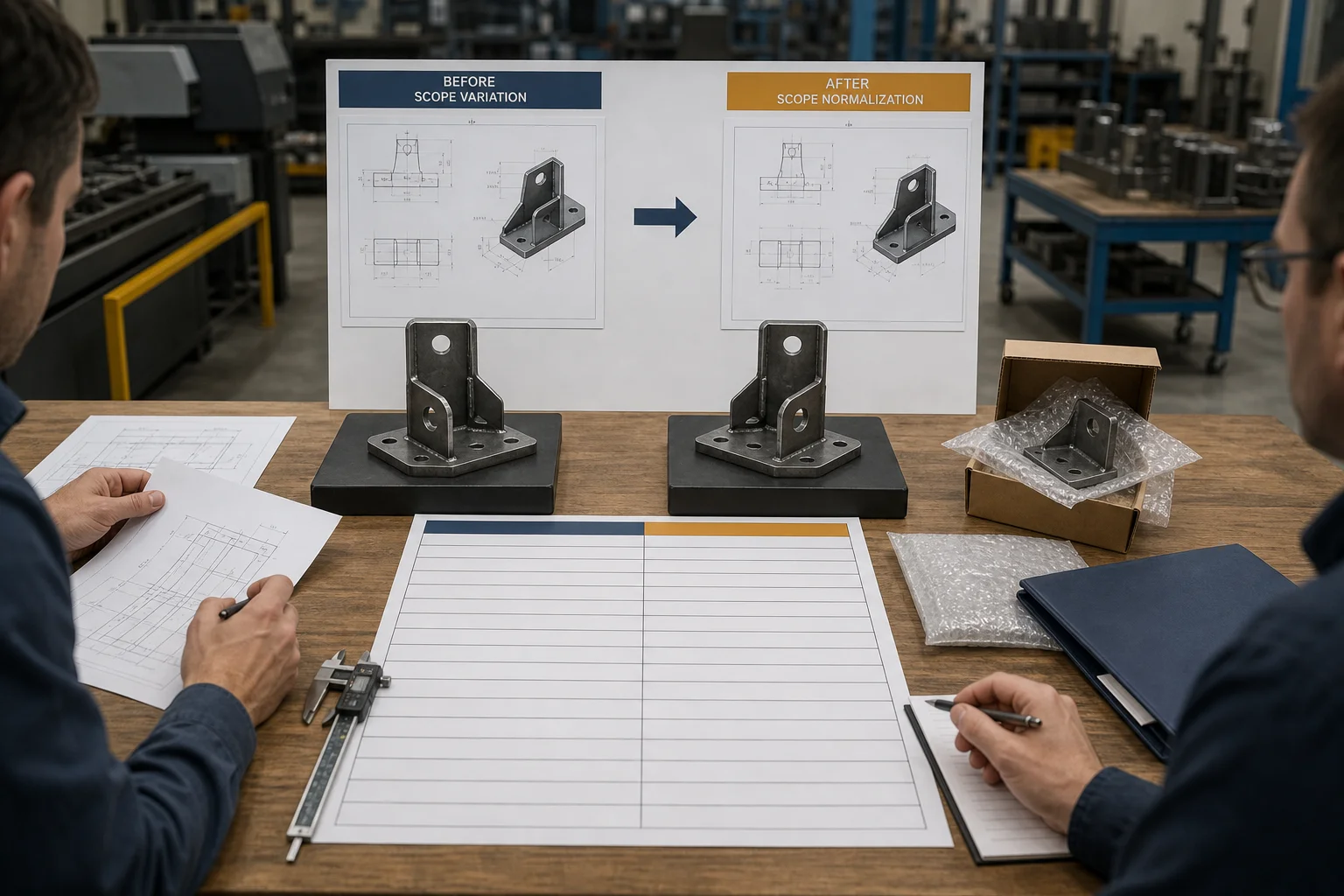
Illustrative editorial image only; it does not show actual supplier quotes, prices, or commercial terms.
Ask for the Nine Lines in Writing — Get a Normalized Quote
✅ Material · Tolerances · Process · Finish · Tooling · Unit basis · Lead time · Incoterm · Payment terms
📩 tylor@xinjiuxinji.com
We respond to inquiries within 2 hours.
Send your drawing with quantity and destination — the reply comes back with the nine scope lines filled in, so you can compare like for like.