How Does a Steel Fabrication Factory Work? A Behind-the-Scenes Look
You are holding a drawing in your hand, with a steel part depicted on it. You know what material it should be made of, what size it should be, and what tolerances it should have. But what happens after the drawing reaches the factory workshop?
Steel Fabrication is not as simple as cutting the steel plate and then welding it together. In our factory, from reviewing the drawing to delivering the finished product, multiple collaborative steps are involved. Technical review, material preparation, cutting, shaping, welding, surface treatment, inspection and testing, packaging and shipping – each step has corresponding standards and procedures.
This article takes you through the complete process in a steel fabrication factory. It’s not a conceptual introduction, but rather what happens every day in the workshop.
What Happens After a Drawing Reaches the Factory?
When a drawing arrives, it doesn’t go straight to the workshop.
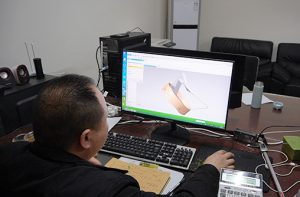 Our engineering team starts with a drawing review. They assess whether the part can be consistently produced with our current equipment and processes. They also identify the most efficient approach and any potential quality risks.
For example, if a certain bending angle is too small, making it according to the drawings might cause cracking. The engineering team flags it and suggests adjustments during the quoting stage. If a tolerance is too strict to hold stably in production—they note that too and confirm whether it can be relaxed. The cutting layout plan for a certain part can be optimized, increasing the steel utilization rate from 75% to over 90% – this is also an opportunity that the engineering team can identify at the drawing stage.
This stage is called DFM (Design for Manufacturing) assessment. Our 19 engineers go through the drawings from beginning to end before the project starts.
After the drawing review is passed, the three-dimensional models are decomposed into the two-dimensional unfolded diagrams of each part. The processing programs for laser cutting machines and CNC machines are also generated. At this point, the production instructions are finally issued to the workshop.
Raw Material Inspection and Pre-Treatment
Steel plates, steel sections, and pipes are transported from the steel mill to the factory and do not enter the workshop for cutting directly.
Quality inspectors first conduct incoming material inspection: verifying whether the material grade and specification size are consistent with the purchase order, and checking for defects such as rust, cracks, or surface blemishes. Each batch of raw materials has corresponding quality certification documents, which will be archived and preserved to ensure that each finished product can be traced back to the source of the raw materials.
Qualified materials then proceed to the pre-treatment stage. Only steel plates with clean surfaces can enter the cutting process – rust and oil stains will affect the cutting quality and also the stability of subsequent welding.
Laser Cutting in Steel Fabrication — Transforming Plate into Parts
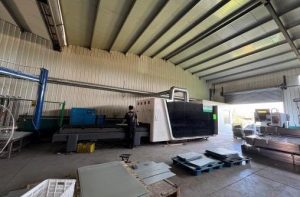 The large sheets of steel were sent to the cutting platform, and the numerical control system automatically completed the cutting according to the previously generated program. Our equipment configuration covers the cutting requirements of different thicknesses and precision requirements:
There are 2 sets of 6-kw laser cutting equipment, suitable for high-precision cutting of medium and thin plates, with smooth cutting surfaces, small heat-affected zones, and superior tolerance control ability compared to plasma and flame cutting. For parts that require subsequent welding or bending, the edge quality of laser cutting can directly enter the next process without the need for secondary trimming.
After the cutting process is completed, the parts will be directed to different stations based on their types – some will directly go to the stamping or bending stations, some will enter the welding area, and some will require further CNC machining.
Forming – Stamping, Bending, and Deep Drawing
Not all parts are flat.
The parts that need to be bent or shaped will enter the forming process. Our equipment configuration at this stage is quite concentrated:
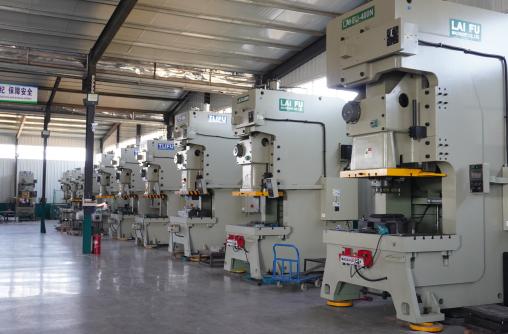
38 sets of 80-400 ton stamping machines, covering stamping requirements from thin sheets to medium-thick plates. The molds are installed on the stamping machines, and through one or multiple stamping processes, the steel plates are pressed into the required concave and convex shapes. For deeper and more complex cup-shaped or box-shaped parts, the deep drawing process is adopted, where the flat material is formed into a three-dimensional shape through multiple stretch operations.
3 sets of bending machines are used for the bending and forming of pipes and profiles. 4 sets of hydraulic presses are used for the forming and correction operations that require greater pressure.
The key to the forming process is controlling the rebound. After the steel plate is bent, it will slightly rebound – at a 90-degree bending angle, it may become 91 degrees when released. Our technicians will compensate for the rebound amount in the programming according to the material grade and thickness, ensuring that the final dimensions meet the drawing requirements.
For parts that require high-precision milling processing, the parts enter the CNC milling machine, five-axis CNC machining center, and vertical machining center to complete the final fine processing of the dimensions.
Welding and Assembly
Many steel fabrication products take their final form through welding multiple parts together.
Welding is one of the most technically demanding steps. Welder qualifications, parameters, filler metal selection, and environmental conditions—every variable affects weld quality.
Before welding, fitters perform tack-up—positioning and temporarily tack-welding parts according to the drawing, then verifying key dimensions. Only after dimensional confirmation do they proceed to final welding.
Our welding equipment includes one automatic spot welder and three welding production lines. Automated welding has clear advantages in volume production—stable parameters, consistent speed, and minimal human variation—making it ideal for repeatable parts. Manual welding remains more flexible for small batches or complex geometries.
After welding, a critical step follows: straightening. Heat from welding distorts steel, and the finished weldment may have shifted from its original shape. Mechanical or flame straightening brings dimensions back within tolerance.
Why does surface treatment matter for steel parts?
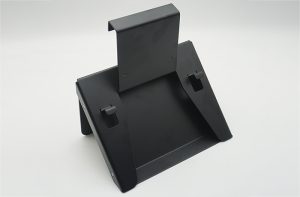
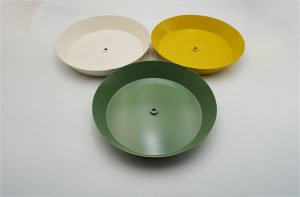
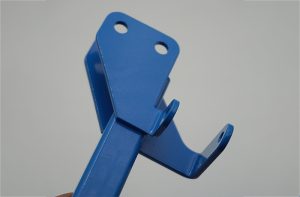
After welding and shaping are completed, the parts have achieved the shape as required by the drawings. However, steel exposed to the air will rust, so most products still need surface treatment.
Our two surface treatment production lines cover a variety of process routes: shot blasting or sandblasting is used to remove oxide layers and welding spatter, and provides the appropriate roughness for subsequent coating; liquid spraying (epoxy primer + polyurethane topcoat) and powder coating meet different appearance and weather resistance requirements; dactyl coating and galvanizing (hot-dip galvanizing or electro-galvanizing) are suitable for scenarios with high corrosion resistance requirements; blackening treatment is used for internal structural components that do not require thick coating protection. The specific scheme to be adopted depends on the product’s usage environment and customer requirements.
After surface treatment is completed, four sets of laser marking machines mark trace codes, specification parameters, or brand logos on the products without damaging the coating, and the content remains permanently clear.
Where Does Quality Inspection Happen in the Process?
Quality inspection is not the final step; it runs through the entire production process.
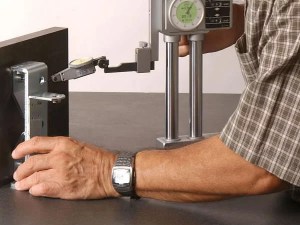 Our coordinate measuring machine (CMM) can quickly inspect complex parts. For parts with high tolerance requirements, CMM is the core tool to ensure batch consistency.
Incoming material inspection: Confirm the material and surface quality when raw materials arrive at the factory.
Process inspection: Random inspection of cutting dimensions, verification of forming dimensions, and inspection of weld appearance during the welding process.
Finished product final inspection: Comprehensive inspection of all dimensions, non-destructive testing of welds (if necessary), and inspection of surface treatment and paint film thickness.
Each batch of products has corresponding quality inspection records. These records are not only the final confirmation basis before shipment, but also the evidence for quality traceability. Quality inspection reports can be provided for each batch of shipments.
Packaging and Shipping
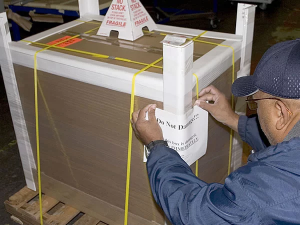 The qualified products then proceed to the packaging stage.
Steel fabrication products are often heavy and irregularly shaped—shipping impacts and friction can cause surface damage. Our packaging solutions are tailored to each product, addressing three factors: secure tie-down (to prevent movement in transit), protective padding (to prevent dents and scratches), and moisture barriers (to prevent rust during ocean shipping).
With mature international logistics and export experience, we have shipped over 70,000 different part types to more than 3,000 customers across 100+ countries. Our stable daily output exceeds 50,000 parts, supported by fully automated, round-the-clock production.
From Drawing to Finished Steel Parts — One-Stop Fabrication in China
✅ DFM-driven engineering · In-house cutting, welding & finishing · On-time delivery
📩 tylor@xinjiuxinji.com — Reply in 3 working hours with free design optimization.
Send your drawings today for a free feasibility review & accurate cost estimate
Frequently Asked Questions
What happens after a drawing reaches a steel fabrication factory?
It goes to engineering before it goes to the workshop. The team reviews the drawing to confirm the part can be produced consistently with the available equipment and processes, identifies the most efficient approach, and flags quality risks before any material is cut. Only then does the job move to the floor: incoming material inspection, cutting, forming, welding and assembly, surface treatment, and final quality control. Putting the review first is what stops a manufacturability problem from being discovered halfway through a batch.
Why is incoming material inspection necessary?
Because a drawing cannot compensate for what arrives at the gate. Steel plates, sections, and pipes come from the mill and are checked before cutting: whether the grade and specification match the purchase order, and whether there is rust, cracking, or surface damage. Each batch of raw material is verified against its certificate rather than assumed correct. If a batch is wrong, rejecting it at the gate is far cheaper than discovering it after cutting, forming, and welding have already been applied to it.
How does the factory control cutting and forming accuracy?
Cutting runs on CNC systems executing the prepared program, with laser cutting used for high-precision work on medium and thin plate: smooth cut surfaces, a small heat-affected zone, and tighter tolerance control than plasma or flame cutting. Forming then follows the part geometry through bending, stamping, and deep drawing, with tooling installed on presses and repeat operations holding the shape. Accuracy at this stage comes from the program and the tooling setup, which is why both are confirmed before a batch starts.
Where does quality inspection happen in the process?
Throughout the route, not only at the end. Inspection supports each stage: material verification before cutting, dimensional checks during forming, weld and assembly verification, and final confirmation of the finished part. For complex geometry and tight tolerances, a coordinate measuring machine is the core tool for confirming batch consistency, because it reports measured values rather than a pass or fail gauge result. The aim is to catch deviation at the operation that caused it, while correction is still inexpensive.
Why Does Surface Treatment Matter for Steel Parts?
Because steel exposed to air rusts. Most products therefore need surface treatment after forming and welding: shot blasting or sandblasting removes oxide layers and welding spatter and creates the roughness that coating needs, followed by a coating chosen for the service environment. It is also the step that protects everything done before it, because a correctly formed and welded part still fails in the field if the finish is wrong for the conditions. Two production lines cover the common process routes and their corrosion and appearance requirements.
How to Choose a China Sheet Metal Fabrication Manufacturer: The 2026 Buyer’s Guide